Observing changes in the back and hind end
The back and hind end take a while to develop, so it can be harder to see changes here than in the front end. Here’s what to look for.
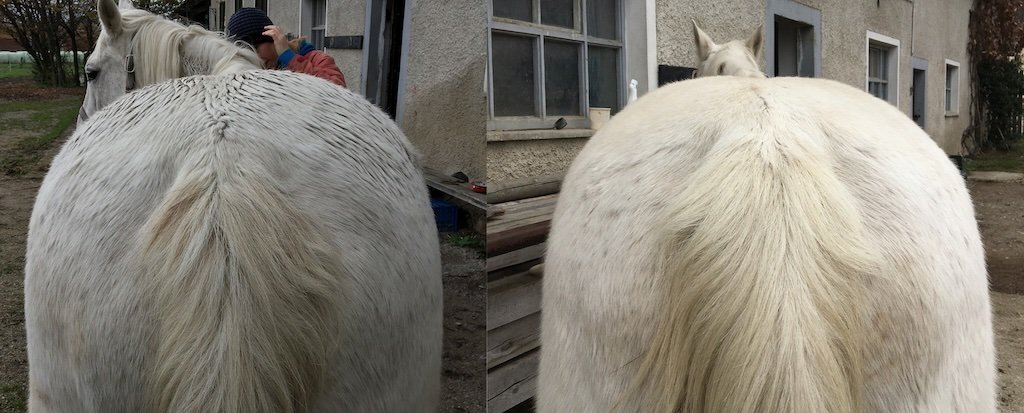
A more symmetrical pelvis due to a combination of bodywork, sound training and good hoof care. This is what we are aiming for.
It always seems like the back and hind end can be destroyed so easily, and yet it takes a long while to build up properly. While the neck and thoracic sling will start to show changes quite quickly, we will need a little more patience with the back and hind end.
A horse who is using his core musculature to correctly stabilize his body and carry the rider, will have a higher muscular tonus even while standing still. Thus, a change we often observe in trained horses is that their back seems to come up more. The transition from the withers to the back should appear smooth, and there should be ample muscle development between the withers and the caudal edge of the scapula. The transition from the back to the hind end should be smooth too. In some horses, we see a muscular bulge extending from the croup through to the lumbar vertebrae. While some riders think that is due to a developed back musculature, this is not the case. The bulge is in fact the gluteal tongue, extending to the lumbar spine. If it is very prominent, it likely menas the long back muscle is not developed enough and is not doing its job properly.
When the abdominal muscles are not active enough, the horse might appear to have a hay belly and obviously, this is not a desirable change. But, on the other hand, abs that ar too tight are not a good sign either. A very prominent line along the back side of the belly with the belly being pulled too far in cau also be a sign of dysfunction. Sometimes, this will go hand in hand with a pelvis that seems to be stuck in flexion. These horses are often sensitive around their bellies and can display unwanted behaviours while being tacked up. This could potentially be a sign of digestive distress.
When observing changes in the hind end, we are looking for even muscular development. The three main muscle groups we are observing are the gluteals (the croup muscles), the quadriceps (the muscles on the side of the thigh) and the hamstrings (the muscles on the back side of the thigh). Often, horses will have overveloped hamstrings and underdeveloped quadriceps. This means the horse is using his hind legs to push, instead of carry. Developing the quadriceps takes time and systematic training, so no need to panic if you don't notice a difference in a short time frame. The important thing is to be mindful of potential overdevelopment and sensitivity of the hamstrings. Another thing to note is symmetry between the left and right side. This is easiest observed when watching the horse from behind. We are looking at the arch of the gluteal muscles from the tuber sacrale to the tuber coxae on either side. Most horses will have some degree of asymmetry in the height of their tuber coxae. The goal of our training should be to make the legs function as evenly as possible, decreasing the asymmetry as much as we can. So, if your horse is more symmetrical in this area than he was last year – good job! If he is less symmetrical this is a red flag that requires your immediate attention. Not all asymmetries can be corrected – but not all asymmetries get in the way of the horses balance and athletic performance. We are not looking for perfect symmetry, we are looking for functional asymmetry.
In the past few weeks we have been looking at some indications of good training that we can observe in our horses. It's always a good idea to assess our horses on a regular basis in oirder to make sound training decisions. However, it's not a good idea to get too hung up on the details. Horses are living individuals. They are not robots, so there are no hard-set rules here. There are horses out there that look nothing like what I'm describing here, but that are able to do their job well and stay happy and sound doing it. And there are perfect looking horses that constantly have aches and pains. So, don't forget to listen to what your horse has to say about his training. This is what matters.