Why does my horse drag his hind feet?
A horse that drags his hind feet is rarely just lazy. Most often the problem starts higher up and needs to be addressed with patience.
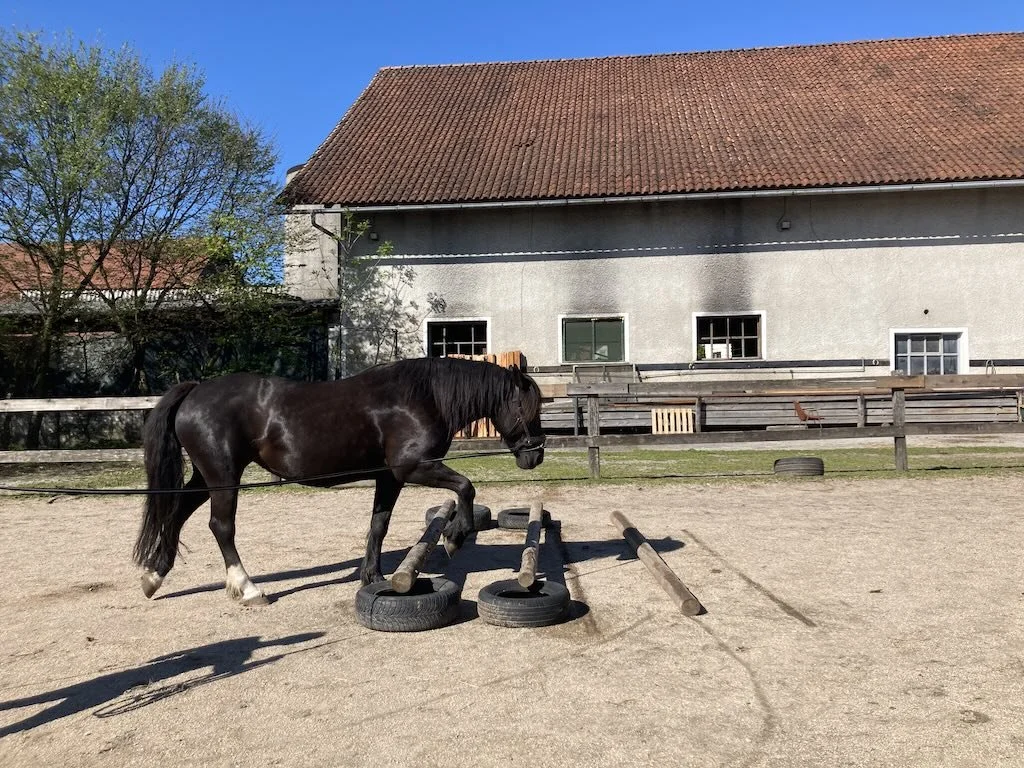
Working over raised poles has a place in rehabbing a horse who drags the hind legs. However, we need to make sure to address the cause of the problem first.
A horse dragging his hind feet is a pretty common occurrence. You can often see evidence of it, even if you just observe the horse standing still. A horse that has a tendency to drag his feet will often have worn the toes of his hind hooves and he will often lack muscle development in the quadriceps region.
Some riders believe that a horse that drags his feet is lazy and they try to correct this by pushing the horse to go faster or work him over raised poles. While this can work in some cases, most of the time it will not solve the problem. That's because the problem often starts higher up.
In order for the horse to actively use his hind legs and step under himself, the back, pelvis and lower legs must all be working optimally. The legs don't move in isolation - they are intimately connected to the motion of the back, especially the lumbar region and the lumbo-sacral joint. If the horse has a problem that prevents flexion-extension in this area, he will have a much harder time lifting his legs up. A key role here is played by the iliopsoas muscle group. This muscle group originates from the last few thoracic vertebrae and the lumbar spine and attaches to the femur and to a lesser extent to the pelvis. It acts to protract the hind leg, flex the hip and also stabilize the lumbar region of the back. It is an extremely important muscle in activation of the hind legs and collection. Very often, dragging the hind legs is a symptom of iliopsoas dysfunction.
There are many reasons why the iliopsoas can become dysfunctional and in order to address the issue, we need to figure out what it is that's causing the problem. It could be an ill-fitting saddle causing general back dysfunction, could be a result of intense training before the horse was ready for it, could be a consequence of an unfortunate fall or slip. In any case, fixing the hind leg drag requires more than just changing the exercise programme. It is often a complex issue that needs to be seen by a professional. How long the horse will need to recover depends on many things – the horse's age, his general fitness, how cooperative and patient the rider and how long the issue has been going on for. In any case, it is well worth putting in the time and effort it takes to rectify this problem – it will pay dividends down the line.