The tricky balance of movement and rest
When dealing with a minor injury, ensuring the right amount of movement is crucial. How to determine what the right amount is and how to get to it, can sometimes be tricky to navigate.
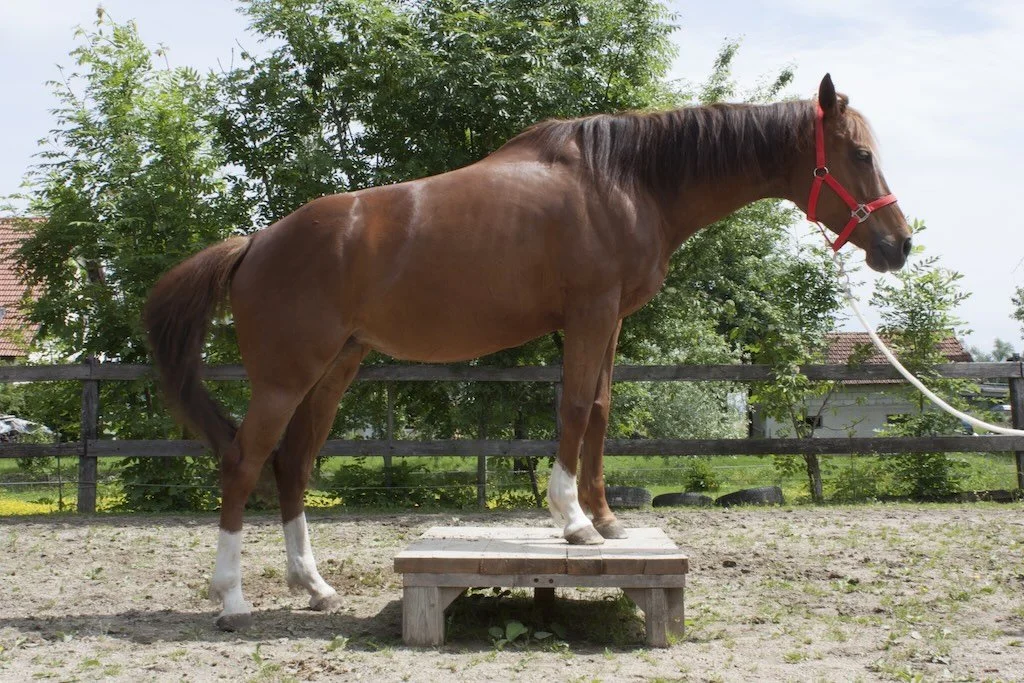
A combination of low impact exercises and mental stimulation can be beneficial in establishing a balance between rest and movement.
Taking care of horses can be both simple and extremely complex. In a nutshell, horses need continuous access to low-calorie forage, lots of low impact movement, and the company of other horses. This can serve as a basis onto which we then string on things like training, balancing a diet, health maintenance and so on. But when something happens that throws the basic foundation out of whack, the situation can suddenly become very complex.
Let's say we have a horse who is naturally on the anxious side, has a slight metabolic issue, but is doing well in a well-established herd living on a track system with access to pasture half of the year. As long as he is in regular work and moves around a lot with the herd, he is ok to be on grass, as he is able to maintain a healthy body weight.
Let's say the horse takes a bad step when running down the pasture and ends up with a mild soft tissue injury. If we want the horse to get better, he still needs to move, but ideally, we don't want him to run around too crazily, especially up and down hills. Now we have a riddle on our hands. How to we tell the horse, who is eager to run around with his friends, that he needs to take it easy? If we lock him in a stall while his buddies are out and about, we will create a lot of stress and anxiety, potentially risking stomach issues. If we allow him to still stay on pasture but stop training him, he will start to gain weight, increasing risk of metabolic issues. If we ignore the injury and act like nothing happened, the injury will take forever to heal, potentially even getting worse. How do we solve this riddle?
Getting the amount of movement right can be tricky. We want him to move enough to have adequate circulation and to avoid metabolic issues, but not so much that he makes the injury worse. In this type of situation, »sacrificing« a buddy with whom he can share the track without having access to pasture can be a good solution. It helps if the buddy is a calm horse who won't make a fuss about not joining the rest of the herd out in the pasture. Another thing we can do is try to increase the amount of low impact movement by implementing a combination of static core exercises and hand walking. How much hand walking will depend on the injury and the vet's instructions. Another thing we can try is mental stimulation exercises. We can try scent work, teach the horse to open boxes to find a (very low calory) snack or we can have fun with learning some tricks. All of this will have a positive impact on both the horse's body and his mind which will (hopefully) add to the injury healing as quickly as possible.
This is what I mean when I say that taking care of horses is very simple, but it can become incredibly complex if something falls out of place. It is never easy when that happens and it pays to have knowledge both of horse physiology and psychology to make these situations as stress-free as possible. This is why we need to always be learning more