Is the problem really in the SI joint?
The SI joints are often blamed for any sort of pelvic dysfunction, but the region is a complex one and there are more factors to investigate than just those two joints.
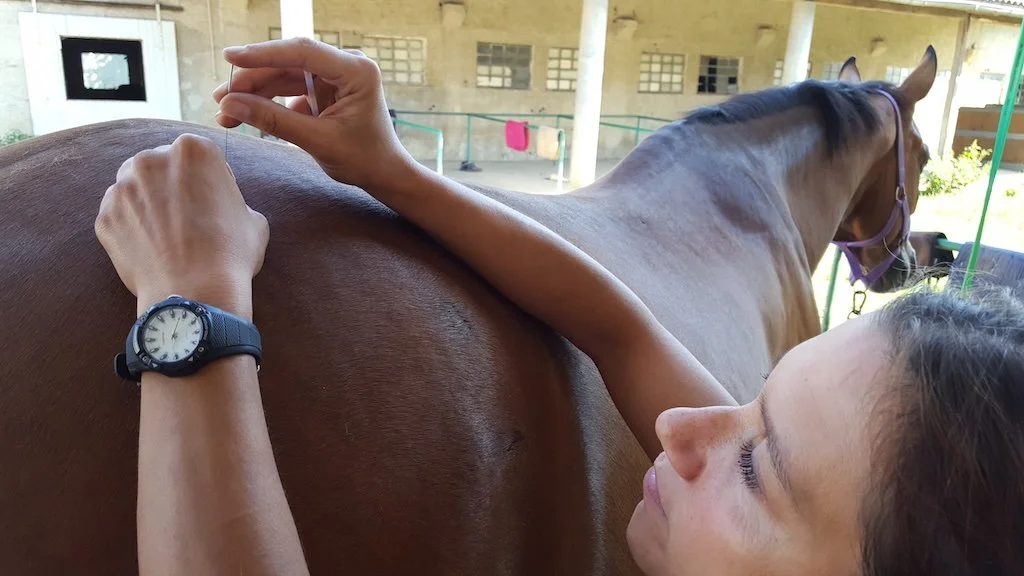
Often, it’s the soft tissues around the pelvis that are preventing the joints from working properly. Different bodywork modalities, including dry needling can release those tissues and restore better function.
Hind end issues are very common in horses and a lot of them involve a problem with force transmission from the powerful hind legs to the spine and front end. Since the junction between the pelvis and the spine (the SI joints) is a key factor here, it's tempting to blame everything on these small joints. But are they really to blame?
The SI joints are two small joints located not at the top of the pelvis (where the sacral tuberosities are), but quite a bit deeper. Often, a bodyworker or vet will point to the sacral tuberosities and say, there was a problem with the SI joints. Which leads the rider to believe that that's where the joints are located. But really, they sit much deeper. Another thing to keep in mind about these joints is that they are not moveable from a locomotion point of view. The movement between the spine and pelvis is very small, only a few degrees. So, the SI joints are not designed to move a lot, but the small movements that they do produce are important for good quality force transmission.
By now you might be thinking »But wait, if the SI joints don't move, how does the horse tuck his pelvis and bring his hind legs underneath himself? «. There is another joint nearby – the joint between the last lumbar vertebrae and the sacrum – that does move a lot. This area has a big flexion-extension range of motion and it's this joint that's responsible for tucking of the pelvis. If you look at a horse skeleton, you will see that the lumbo-sacral and the sacroiliac joints are located pretty close to each other. Therefore, it's very easy to spot dysfunction in the area and then blame it on the wrong joint – the SI. Often, the problem really lies with the lumbo-sacral joint.
Another thing to keep in mind is that joints do not function in a vacuum. They need muscles and soft tissues to move about. Often, the reason why the joint has a compromised functionality is not the actual joint itself, but the surrounding soft tissues that are not functioning well enough to enable the joint its full range of motion. Tight muscles of the pelvis can prevent both the lumbo-sacral and sacroiliac joints to function the way they are intended to. So, maybe we just need to be more precise when it comes to which words we use. It's easy to say the problem is the SI joints, when in reality, it's the soft tissues around them. The pelvic region is a complex one, and sometimes it's hard to know exactly where the problem lies, unless your palpation and observation skills are exceptional. Not every problem is an SI problem and it helps to keep an open mind when it comes to the hind end.