Test the thoracic sling
The thoracic sling is an important area. Here are two things you can do to test how well this area is working in your horse.
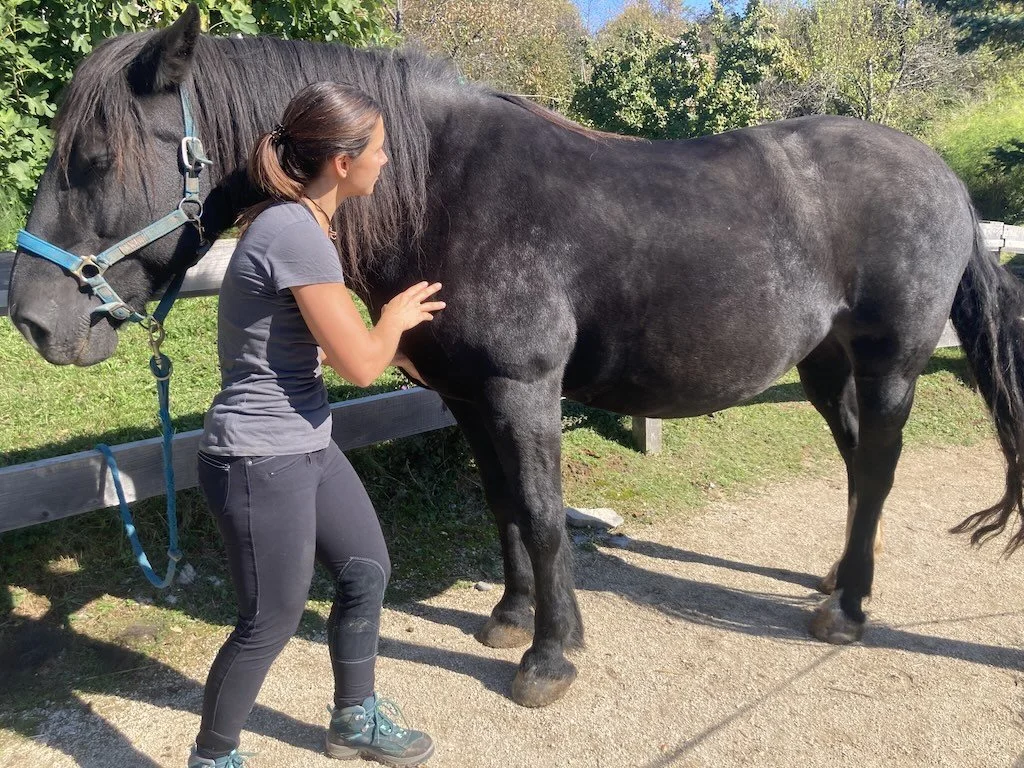
Place your hand on the sternum and push upwards, towards the withers. The horse should be able to lift this area slightly, and bring it back down. Any resistance might indicate a problem.
We all know the thoracic sling and the base of the neck are two incredibly important areas of the horse's body. In order for the horse to carry the rider in a healthy way, he must be able to lift his torso up between the shoulder blades, lifting the base of the neck and placing the spine in a more neutral position. In order for him to achieve this, he must be able to do two things (well, more than two, really, but let's keep it simple): he must be able to move (lift) the junction between the last cervical and first thoracic vertebrae and his shoulder blades must be able to glide along the ribcage.
Obviously, if we want the horse to do both those things under the rider, he must also be able to do it without a rider. If he is not able to do it without the rider, it is unlikely that he is able to do it with the added weight. So, here are two tests you can do to get some information about how well this area is functioning.
First, we want to know if the horse's shoulder blade can slide along the ribcage. This will only be possible if the muscles surrounding the shoulder blades are elastic and working well. To test this, lift up the horse's front leg and bring it into protraction (forward). Then let the leg relax downwards, so that the hoof gradually touches the ground about a hoof length in front of the opposite leg. If you observe the elbow joint, it should slowly move downwards. The horse should be able to do this movement without having to put weight on the leg in front and without jerky movements. If the horse can't »lengthen« the leg downwards or if he does it in a sudden way, slamming the leg down, then there might be some restriction around the shoulder blade present. Do this on both sides and compare.
Next, have the horse stand (relatively) squared and relaxed. Then place your hand on his chest (where the sternum is) and push upwards, towards the withers. You should see the horse's thorax move up just behind the scapular cartilage. The movement is subtle and can sometimes be easier to see when the torso goes back down as opposed to when it's going up. Observe the quality of the movement. Does it feel elastic and gradual or does it feel like you're pushing on a rock? Does the horse enjoy this movement or is he showing signs of discomfort? Try these tests several times and on several different horses to get a feel for them.
These tests are not diagnostic tools and should not be treated as such. Obviously, assessing the health and functionality of the thoracic sling is way more complex than this, but these two tests can give you some important information about how healthy this area is. If you find your horse is struggling with one or both of them, consider having a professional out to assess your horse more thoroughly and provide insight into how to improve the functionality of the base of the neck and the thoracic sling.