Downhill problems
Struggling with downhill movement can be a lack of core strength or it could indicate pain – or both.
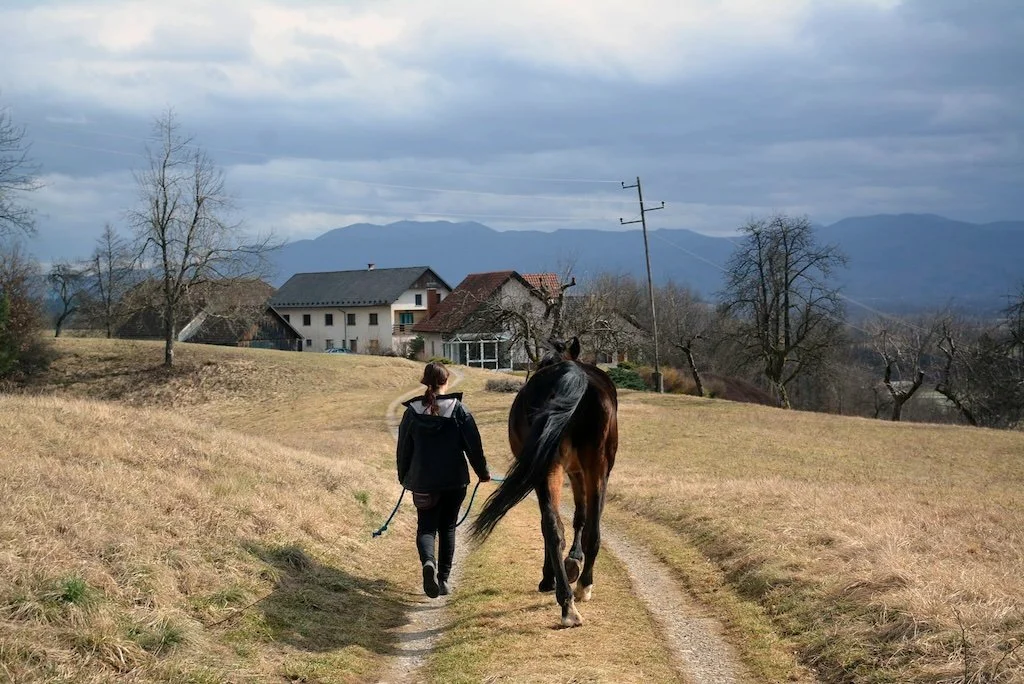
Walking downhill can be tricky if the horse lacks the appropriate muscles. Taking the time to build them will help develop strength, balance and coordination.
Hill work – both up and down, can be a great exercise for strength, coordination and balance. And while uphill intuitively seems like the harder of the exercises, horses actually tend to struggle more on the downhill. Why is that?
Think of walking down a steep hill. Will you tend do lean forward or backward to prevent your body from tumbling down the slope? Intuitively, you will lean backwards, shifting your centre of gravity. The horse carries most of his weight in the front end, which makes walking downhill tricky. They have to do the quadruped equivalent to leaning backwards to prevent them tumbling down. Tackling downhill work requires the horse to engage his core muscles, as well as the thoracic sling and the hind end muscles, which are used for breaking. This means that walking down a slope requires a functional thoracic sling, strong abdominal muscles and a strong hind end.
Horses that struggle downhill will very often try to rush down. They might fidget, pace or try to go sideways. Often, the rider will report that they dismount when going downhill, otherwise they fear the horse would just run off. Running off is a normal response to a lack of balance. The horse is afraid he is going to tumble down the slope, so to prevent from falling, he wants to run down. (We can see something very similar when a horse starts to go faster and faster and faster on the lunge line.) Fidgeting and going sideways achieves the same goal. Some horses voice their frustration (discomfort/pain) by head tossing or stopping to rub their faces on the front leg. In some cases, the horse might even romp or buck. The two main reasons why a horse would struggle downhill are a lack of core musculature and pain – these two often go hand in hand.
If the main problem is a lack of core strength, it makes sense to put some effort into building some. You can achieve this with static core exercises, in-hand and lunge work. Working on good posture and balanced movement will automatically improve core strength as well. Of course, you can also start with shorter and less steep downhill work, gradually progressing to longer bouts and steeper terrain.
If the horse has sufficient core strength or if he starts to act up on the downhill out of the blue, this most likely means pain. It's hard to say exactly where the pain is if the horse struggles downhill, as every horse has his own way of compensating. Common issues are elbow pain, front hoof pain and pain in the SI area, but it could be many other things as well. Sometimes, the horse will be just fine on flat ground or when going uphill, so issues with downhill movement can be an early warning sign that something is off. It's easy to ignore it and say that the horse is impatient or that he simply dislikes going downhill, but in the long run, it's a better idea to take the message seriously.