Different gaits, different spine movements
The spine moves very differently in each of the three basic gaits. Understanding these differences can help you make better training decisions.
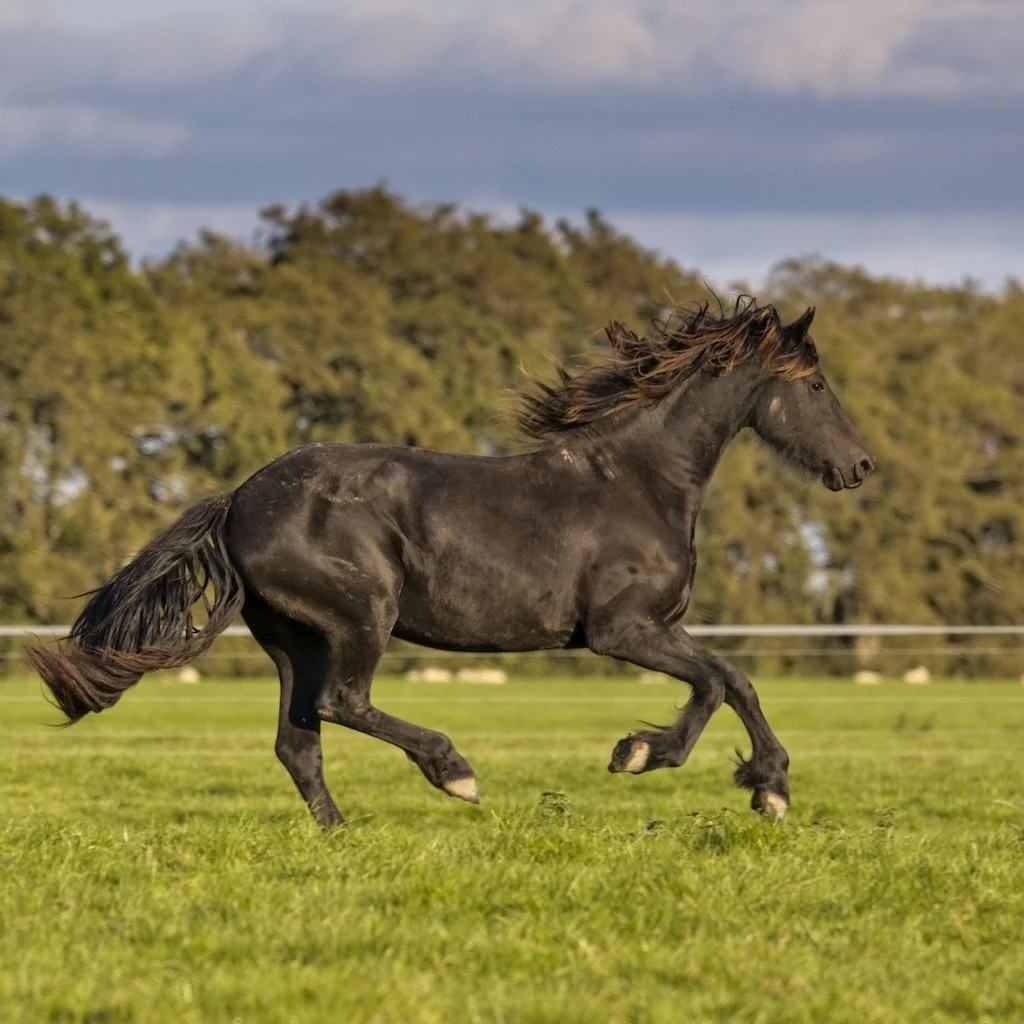
The spines moves very differently in gallop than it does in walk or trot.
The spine plays a vital role in the horse's biomechanics and his athletic ability. If we want the horse performing well, he needs both a spine that is able to move well in all directions as well as specialized muscles, overseeing and controlling those movements. Optimal spinal function is like a very complexed, well running machine.
But training for optimal spinal movement is a tricky thing. Too much mobility and the horse is prone to soft tissue strain, not enough mobility and the horse becomes stiff and the limbs pay the price. Many of today's horses are hypermobile, meaning that they have a very high natural range of motion. This means the horse has good athletic potential, but it also means that we will need to spend a significant amount of time building up enough stabilizing power. On the other hand, we often see horses with very stiff spines, due to improper training and compensation patterns. So, sometimes the horse needs an emphasis on developing stability and sometimes he needs to work towards a better range of motion. It's not that these things are polar opposites, in fact they are complementary and we often need to work on both.
When thinking of optimal spinal function, it pays to understand what kind of effect each of the gaits has on the biomechanics of the spine. This enables us to make training decisions, better suited to our horse's needs.
The walk is a very stable gait, since two feet are on the ground at all times, so it requires less active stabilization of the spine. This means there can be a larger range of motion between the individual vertebrae. The spine moves in flexion and extension, as well as lateral flexion. When in lateral flexion, there is also some rotational movement. This makes the walk a great gait for gentle spinal mobilization, especially if we add some poles or cavaletti.
The trot is a different story. It is a two beat, diagonal gait with an airborne phase, so naturally it requires more stabilization. The spine moves into flexion and extension passively, because of the inertia of the viscera, and the abdominals and back muscles work to limit that passive flexion and extension. The spine itself has a smaller range of motion that walk. So, trot is better for strengthening the bigger stabilizing muscles, but not great for mobilization.
The canter is a three beat, asymmetrical gait with an airborne phase, but the movement is very different from the trot. In the canter, there is a huge amount of flexion and extension in the spine, especially the lumbo-sacral joint. The abdominals are working actively on both sides to flex the spine and the thoracic sling muscles are working hard too. The canter, and even more than that, the gallop, can be a great way to get more movement in the lumbo sacral joint for horses that struggle with stiffness there. I am not saying we need to gallop the horses that have dysfunction and pain in the lumbar region. I am saying that the gallop can have a beneficial effect, if incorporated into a comprehensive rehabilitation programme.
This is a very broad overview of the spinal movements in gaits, but hopefully it has given you some food for thought. The three different gaits are all important and all play important roles in training our horses.