Bodywork for difficult horses
Some horses have a hard time relaxing when being touched and these are often the very horses that need bodywork the most. In these cases, patience, time and empathy go a long way.
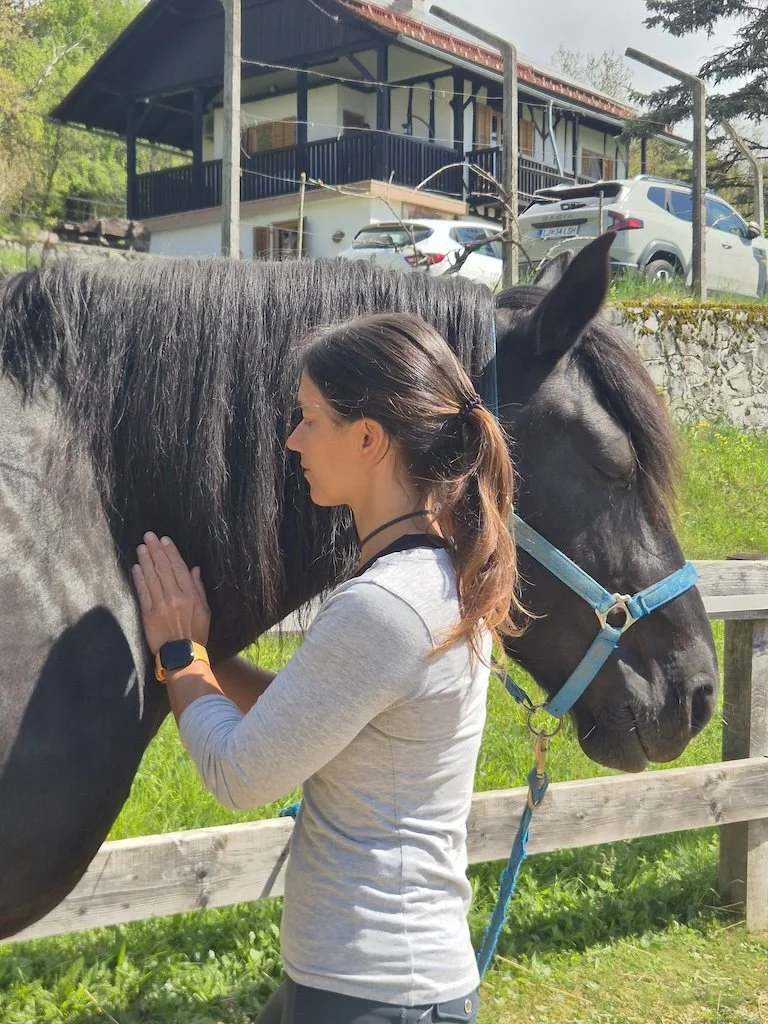
Developing trust takes time and patience.
While most horses enjoy bodywork and are more than happy being touched, scratched or groomed, some can be quite aversive to touch. Often, this is due to bad experiences in the past which have taught the horse that being touched by humans is not safe. Very often these horses have other issues too, both psychological and physical. Bodywork is therefore very beneficial to them, but what do you do when the horse has a hard time feeling safe enough to allow a bodyworker to work on them?
One approach is to tie the horse up or hold him firmly and »make him« stand there for bodywork. This will have very limited benefits in terms of bodywork and can be counterproductive when it comes to the horse's psychological issues. If the horse does not feel safe and feels like something bad is being done to him, he will be in a sympathetic state. When the body is an a sympathetic (fight or flight) state, this has an impact on the soft tissue, especially fascia. Since the nervous system perceives that the horse is in danger, it will prepare the body to run for its life. Good luck releasing a muscle in that state. It's nearly impossible to make any lasting change in the tissues when the horse does not feel safe.
So, when working with horses that do not like to be touched, the feeling of safety is the number one concern. This can be tricky, as the horse can appear relaxed but then freaks out every time you put your hands on them. The trick here is to take it very slow and to anticipate the horse's reactions. Find a place where the horse is ok with touch, and simply out your hand on. Then, as soon as the horse even starts to think about moving away, take your hand away. Repeat this several times. The idea is to tell the horse that he has all the control. He decides when the touching ends. He decides when there's too much pressure. The feeling of control enhances the feeling of safety and makes the horse more relaxed.
When a horse understands that you will stop if he asks you to, two things will happen. Because you will be a better listener, the horse's reactions will become less exaggerated. Instead of trying to run away from you, he might just lean away or turn his head. This makes the whole experience nicer for both you and the horse. And number two – and this is the big one – because the horse knows that you will respect his boundaries, he will allow you to do more and more work. With this approach, most horses tend to relax by the end of the session and by next session, they are much more eager.