The often-overlooked latissimus dorsi
A tight latissimus dorsi can have a negative impact on the range of motion of the spine, as well as the front leg, so it makes sense to keep an eye on this often-overlooked muscle.
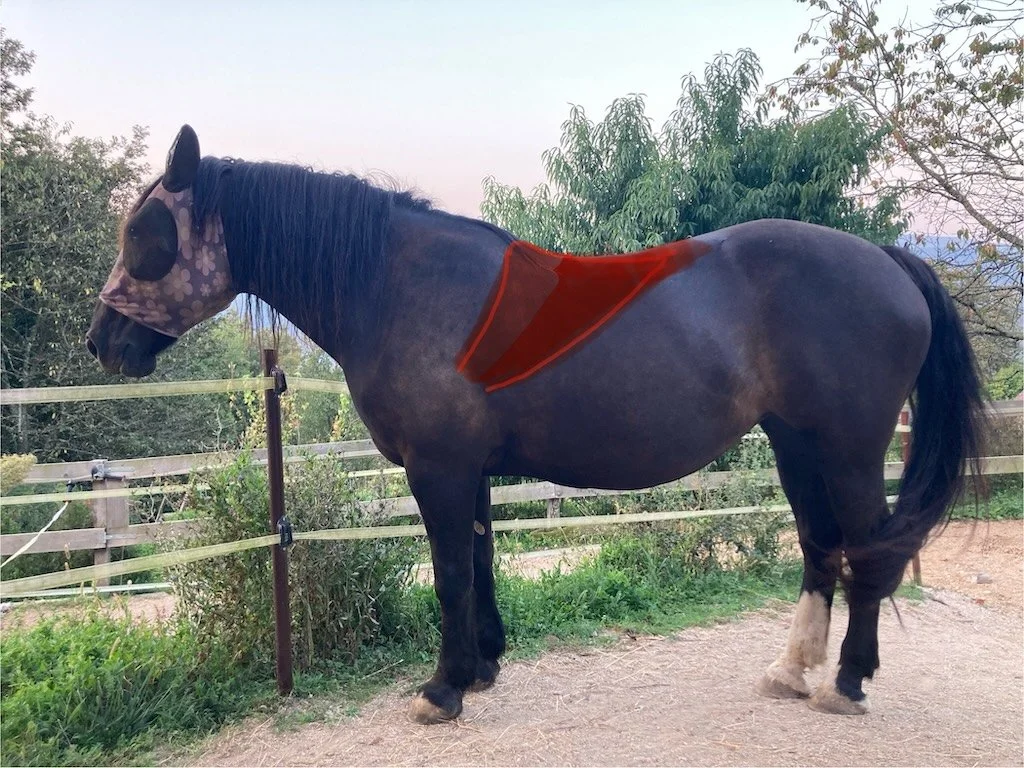
The latissimus dorsi is a large muscle spanning from the thoracolumbar fascia to the humerus.
One of the muscles that doesn’t get talked about that often is the latissimus dorsi. Unlike its cousin, the longissimus dorsi, latissimus doesn’t get mentioned when we talk about back pain or back dysfunction. But it's worth knowing more about it, as it can play a big role in the way your horse moves.
Latissimus dorsi is a large muscle that covers a lot of surface, but it's not particularly bulky. It starts off from the thoracolumbar fascia as a wide sheet of muscle, covers the ribs, and attaches to the inside of the humerus. So, it connects the lumbar region of the back to the front limb. It helps retract the front limb, and it also aids in propelling the body forward over the planted front limb. Given its position and shape, it’s no surprise it also aids in trunk stabilization.
Many things happen when this muscle is tight. It can hinder the front leg’s ability to protract, reducing overall range of motion and making the horse’s stride choppier. If the muscle is tight on both sides of the trunk, the horse can have a reduced ability to flex laterally, making correct bending more difficult. Since a tight latissimus dorsi negatively impacts the range of motion of the spine, the horse might also have a harder time lifting through the back. If the latissimus dorsi is only tight on one side, this can make the horse appear crooked. The horse can have trouble traveling on two tracks, and it can have difficulty bending to the unaffected side. Tension in the latissimus and the lumbar area of the back very often go hand in hand, too.
Due to its superficial position, the latissimus dorsi responds really well to bodywork, especially myofascial work. If you have a horse that has a hard time protracting the front limb and has very stubborn tightness in the lumbar region, give the latissimus dorsi some love and see how the horse responds. The part of the muscle that you want to be working with is the lower edge, spanning over the ribs and attaching into the thoracolumbar fascia. You can visualize it as a line going from the middle of the humerus to the last few thoracic vertebrae. Think about unsticking this line away from the ribs. Position your fingertips on the edge of the muscle and direct your pressure upwards, not inwards. Move along the entire length of it, spending more time in areas that feel sticky. Go slow and take time to unstick the fascia along the edge of the muscle. If you’re unsure whether or not you’re in the right spot, don’t worry - a general myofascial release along the ribs is always welcome. Do this on both sides of the horse, then test the protraction again. If you did a good job, it should now be easier for the horse to relax his leg forward and down. If the tightness has been present for a long time, you can add a little somatic exercise to show the horse his new range of motion. Put one palm on the front of the ribs and one palm on the back of the ribs, then gently bring the palms together, asking for subtle lateral flexion through the ribcage. Repeat a couple of times slowly, then do the same on the other side. Once you’ve released the latissimus, it might be easier now to address the lumbar tightness as well. Adding work on the latissimus into your bodywork routine can be very beneficial, so make sure to think about this overlooked muscle the next time you put your hands on a horse.