It's been five years since we set up our mini track system and I have to say, it's holding up pretty well. Some things we did really well from the start, but of course, we made some mistakes too. Here are a few things that I have learned in those five years.
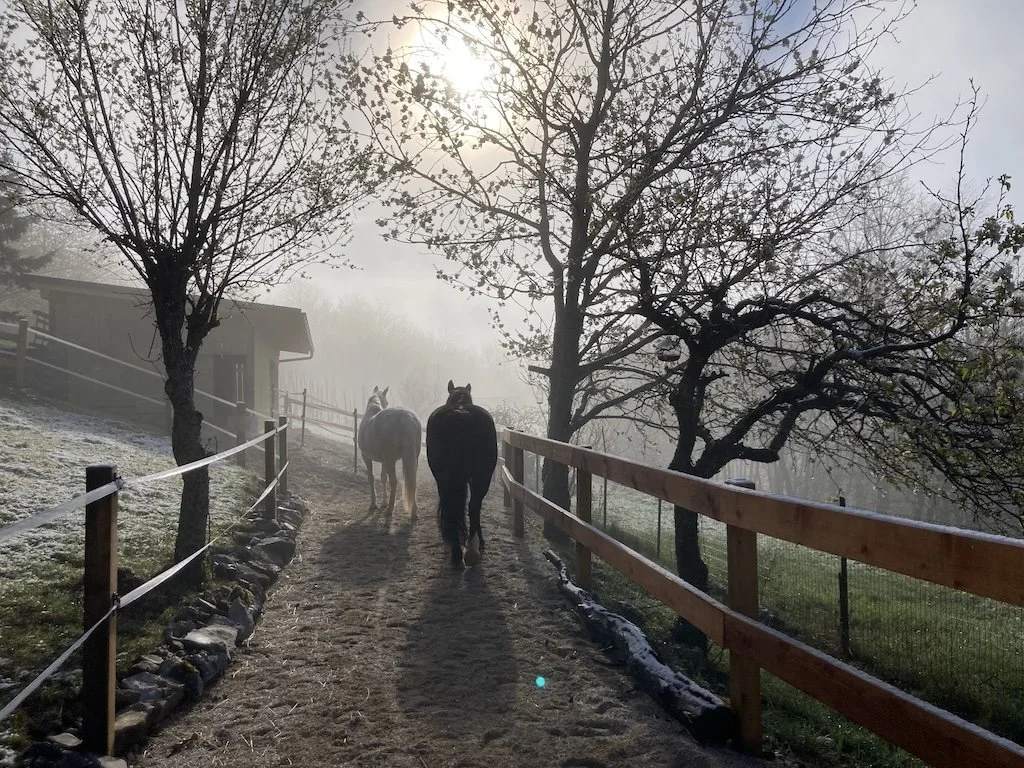
A track system works really well on a small property.
Let's first talk about things we did well. Feeders with clip in nets are a great way to feed hay. We have two feeders, a bigger and a smaller one that fit three big hay nets. The nets are big enough to fit a whole square bale (about 15 kg). Once it's in, I just cut the bale ties and pop it in the feeder. The net attaches to the inside of the feeder with two carabiners. I found out pretty soon that one of the carabiners has to be the one that you can screw closed. Otherwise, they find a way to unclip them and throw the net out. Horses are amazing creatures. This way of feeding enables them to eat in a somewhat natural position, the small holes in the nets prolong feeding time and the feeder reduces hay wastage.
Another thing I'm quite happy about is the fencing. Initially, it was a big cost, but we got the 10cmx10cm oak fence poles and the thicker (5cm) planks for the fence. I have not had to fix it once in five years. At the sides of the track, where the sand ends, I put thinner (about 15 cm diameter) tree trunks to keep the sand in place. At the time, I thought it would be a very temporary solution, but it has actually worked quite well.
And then there were some things we did not do well. The first lesson is that slopes are alive. Our track is built on a hill, so it's basically in two levels, which means there are a few slopes on it. Great for working those muscles, but they change a lot with repeated use and weather. Especially problematic is the slope that goes from one feeder up to the shelter. Since they use that one more, it has changed more and as time goes by, they had less and less space under the shelter. The ground was eroding away big time. We had to bite the bullet and invest in some mats for slopes and some repair works for the space under the shelter. Hopefully, this will solve the problem.
Another thing we did not do well is the space around the feeders. Initially, we got some cheap, non-horsey rubber mats, but they fell apart pretty quickly and after five years they have just disappeared. We replaced them with high quality ones and hopefully, they will do a better job.
All in all, I am still very much in love with our little track system and I would highly recommend it. On a daily basis, it's not that much work at all and the changes in the horses have been amazing. Sure, it's a bit of an investment, but well worth it. I am looking forward to the next five years with the track!