Just because they can compete, doesn't mean they should
Poor performance can be a very subtle symptom that many riders fail to notice. Here are some things to look out for, especially as your horse progresses to higher levels.
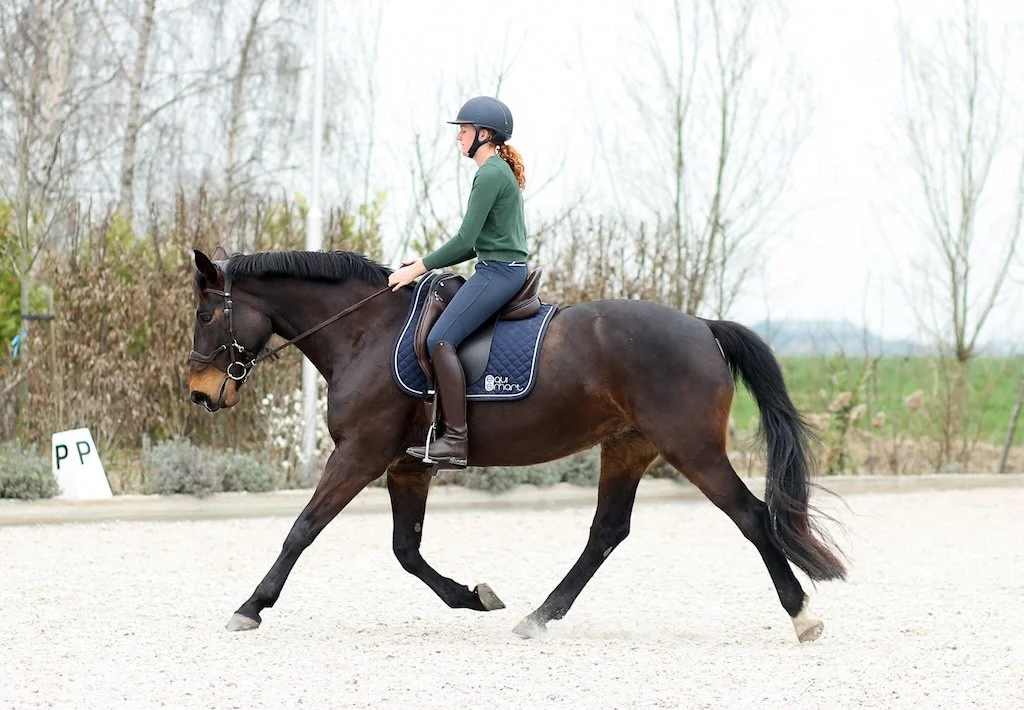
As the horse progresses to higher levels, he should become easier to ride, not more difficult. (photo courtesy of Esther Berger)
Poor performance is usually one of the first symptoms of dysfunction in the horse's body. The initial symptoms can be quite subtle – there might be a slight reluctance to go forward, less sensitivity to leg aids, or the rider might feel like they have to micro manage the horse a tiny bit more using the reins. The symptoms can become worse so gradually, that the rider doesn't even notice until it starts to take a whole lot of effort to just ride the horse through basic gaits and turns. And even then, some riders will just continue to ride the horse through it. A good enough rider can make the horse do a whole lot more than he is comfortable with. And that can be a huge problem in the long run.
Every now and then I come across a horse who shows a lot of signs of dysfunction and weakness and yet somehow, he still competes and does quite well in competitions. So, when I point out that the horse might benefit from taking a few steps back to develop proper musculature and posture, the answer I get is »but he just came second in this and that competition, surely there is nothing seriously wrong with him. « If the judges say he is performing well, who am I to disagree with them?
But here's the thing. Horses are amazing creatures. They owe their lives to their athletic ability and they have the amazing capacity to run even if their back hurts, even if they're lame, even if they are ill. When the tiger jumped out from the bushes, the horses had to run, regardless of how they were feeling. Either that or they would become lunch. We still see this in horses today. They are able to mask their pain and hide their discomfort and leave their heart there in the competition arena. That's one of the reasons why they make such great athletes.
Another reason is their great ability to store elastic energy in their soft tissues and use their tendons and fascia to project them over obstacles (or perform dressage elements or run really, really fast) with apparent ease. Many horses will be able to perform amazing feats just by using elastic recoil. This is especially true for the extra bouncy modern sports horse. In this way even horses who very clearly lack appropriate musculature are able to perform to relatively high levels. The problem is, it isn't sustainable. Muscles need to be there for a reason and if they are not, other tissues will take the brunt of the burden of performing. And eventually, that burden will become too much to bear and the horse will get injured.
Sometimes, it can be hard to differentiate between a horse that is performing in a sound way and a horse that is doing long term damage on its body. But if you look and listen, the signs are almost always there. Muscles tell one story – we have talked about that intensely in previous posts. The rideability tells another one. Seemingly small things, like uneven bending left and right, a more difficult canter departure on one hand, stiffness that takes longer and longer to warm the horse out of... all of these are signs that something is not ok. Of course, no horse is perfect and every horse has its own training issues that the rider needs to work on. But, as the horse's level progresses, the number of issues should go down, not up. As the horse gets better at his job, he should also become easier to ride. If your horse is becoming increasingly more difficult to ride, you need to go backwards, not forward.