Here are some gentle bodywork techniques to help with tension around the lumbo-sacral joint.
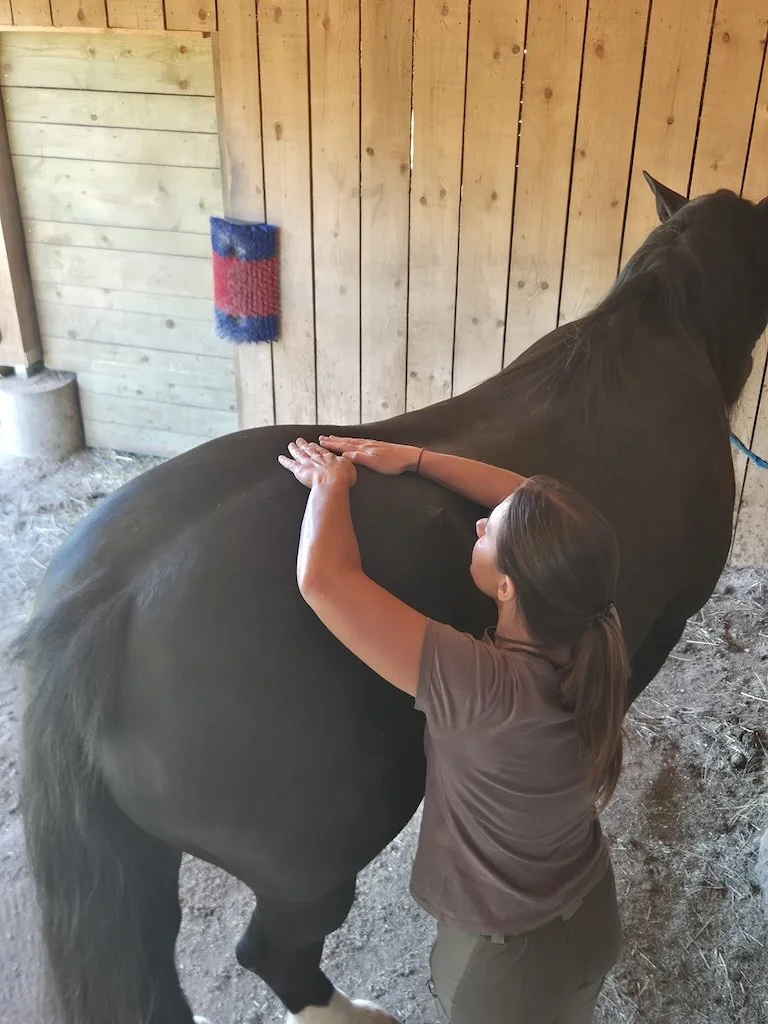
Engaging the skin just over the lumbo-sacral junction will help release tightness in the superficial fascia.
The joints between the last lumbar vertebra and the sacrum are very important. They enable the horse to tilt his pelvis, which is crucial in hind end engagement, jumping and a good quality canter. I find this area to be problematic in a lot of horses, so here are some easy things you can do to help these important joints function optimally.
Being able to locate this joint on your horse is a valuable skill to have and it's not hard to learn. Start by placing your fingertips in the tops of the spinous processes of the lumbar vertebrae. Follow the bumps toward the tail. In the lumbar vertebrae the tops of the spinous processes, the bumps, are spaced relatively evenly apart. When you get very close to the sacral tuberosities, there will be a bigger space between the last lumbar spinous process and the first bump on the sacrum. This bigger gap is where the lumbo-sacral joints reside.
Once you find this area, let your fingertips rest here for a while, and pay attention to your horse's reaction. If he is ok with it, you can try adding a little pressure (only a little!) and observe your horse again. Imagine the tissues around the joint releasing and feel how comfortable your own lumbo-sacral area feels. Next, cover the area with the palm of your hand. Move the hand in all directions with just enough pressure to engage the skin. Imagine pulling the skin over the muscles and bones. This will engage the superficial fascia, which is often stuck and sticky in this area. If you feel like the skin moves easily in one direction, but not the other, try engaging the skin in the harder direction for longer. This can be uncomfortable if done forcefully, so make sure you stay gentle.
Another area you can work on is just cranially of each of the tuber sacrales. This time you are not working on the gap between the spinous processes, but on the area just adjacent of the spine. Find the left tuber sacrale and place your fingertips on the area just cranially of it. Let your fingertips rest there and slowly add a little pressure. Observe the horse's reaction and adjust the pressure to it. Then repeat the same on the right side.
Finish this mini bodywork session by stretching the hip flexors. Take the horse's leg and bring it backwards, then rest the toe of the hoof on the ground, about two hoof lengths behind the other leg. If this is comfortable for your horse, let him rest in this position for about 30 seconds, then repeat on the other side. You can do this sequence after work or as a standalone routine. If your horse reacts negatively to any of these techniques, even if you are being very gentle, make sure to consult a professional.