The sacro-iliac joints are often blamed for any hind end issue. But is it possible that the real problem lies in a different joint? The lumbo-sacral joints play a big role in the horse’s locomotion and they are worth paying attention to.
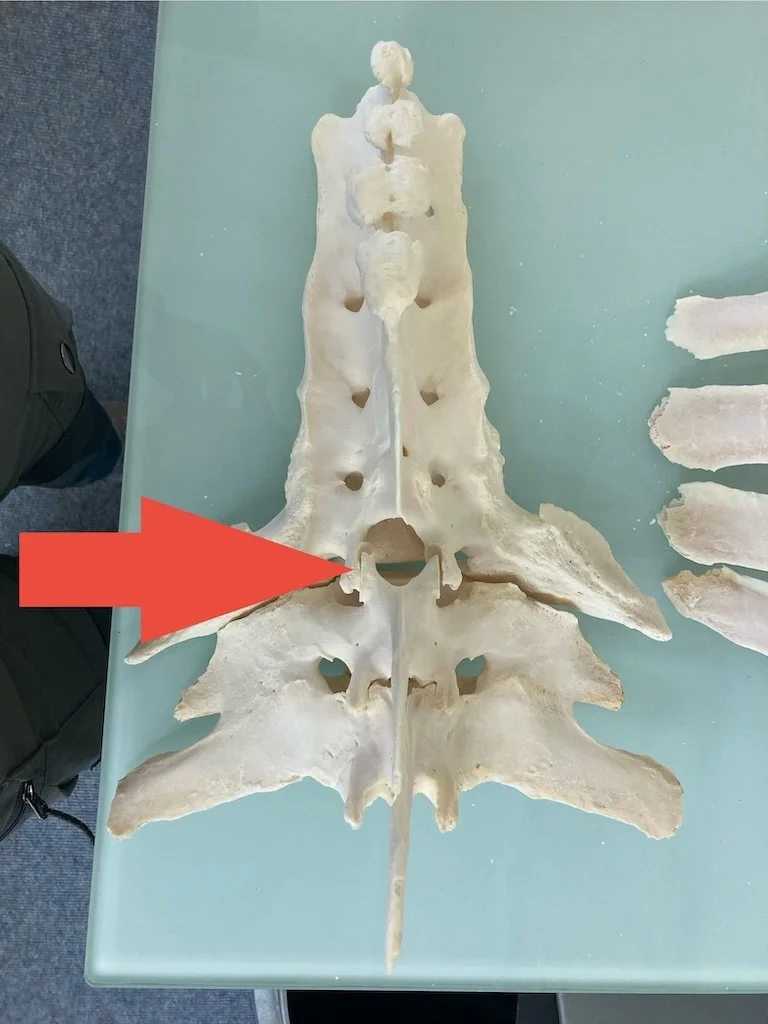
When we are talking about issues in the hind end, especially around the pelvis, we like to blame the sacro-iliac joint for a lot of problems. The sacro-iliac joints seem to have become very popular scape goats for any hind end issue. But, do we really know enough to justify saying that? Is it possible we are looking at the wrong joint?
The sacro-iliac joints are the joints connecting the pelvis to the cranial end of the sacrum. They sit deeper than most people realise and are very low motion joints. They are not meant to move all that much at all and this is ensured by lots and lots of ligaments, muscles and connective tissue stabilizing this area. But sitting really close to the sacro-iliac area is another pair of joints, the lumbo-sacral joints. This is the connection between the last lumbar vertebrae and the sacrum. In contrast to the SI joints, the LS joints are very moveable. They enable a huge degree of flexion and extension and it's what enables the horse to bring the hind legs underneath his body. These are the joints that are key to accessing the power of the hind legs. They play a huge role in collection, jumping and galloping.
Something that I find in a lot of horses with hind end issues is tension and a limited range of motion in the LS joints. Very often this area will be »stuck« in flexion, giving the pelvis a steeper angle than it should have. This alters the biomechanics of the hind legs, overworking certain muscles and underworking others. The result is very often tense hamstrings and adductors and weak quadriceps. This combination will make the stifles unstable and might cause the patella to become »sticky«. It's a whole cascade of negative effects.
I find that with these horses, focusing on the LS joints and the tissues around it, instead of the SI joints can give better results. Restoring healthy range of motion in this crucial area enables the horse to start using the muscles of the hind legs more evenly. So, if you have a horse that has persistent hind end issues and you suspect »a sacro-iliac joint problem«, take a look at the lumbo-sacral joints too. The real problem might lie here and it's easier to access than those deep lying SI joints.