Relieving back pain during chronic lameness
Chronic distal limb lameness causes the horse to adjust how he uses his entire body, causing tightness and restriction in the back. Here are a few simple massage techniques you can use to help your horse.
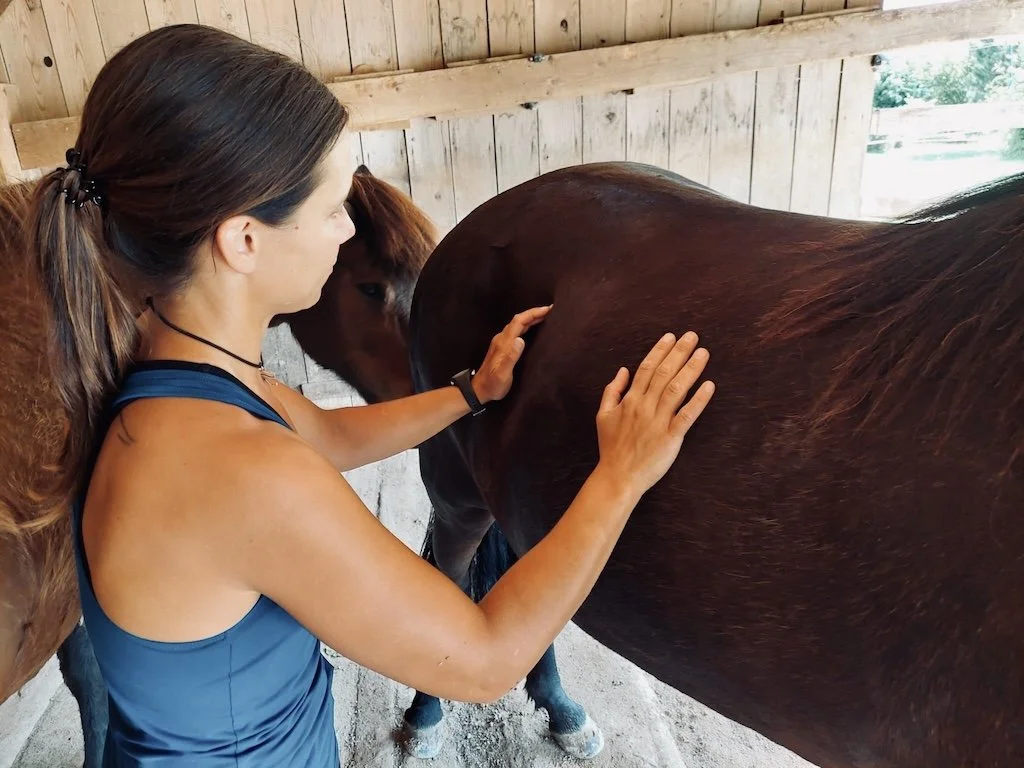
Working along the caudal edge of the last rib requires a light touch and paying attention to the horse’s reactions.
The distal part of the hind leg is a common site for arthritis and other pathologies resulting in chronic lameness. Horses struggling with distal hind limb issues often have good days and bad days. Even though there are some conditions we cannot reverse (like joint deterioration), we can take steps to relieve discomfort.
A horse with a chronic condition should be regularly monitored by a vet, seen by a bodyworker to work out secondary problems and put on a strict hoof trimming schedule. In addition to this, you can help him by providing lots of low intensity movement (turn out or light work – depending on the severity of the issue), a balanced diet and potentially any supplements that your vet recommends. In addition to all of this here is a simple massage sequence you can do when you see your horse is having those not-so-great-days.
When the distal limb is painful, the horse will change his way of moving to minimize impact on the painful area. This will mean changes in how he uses his entire hind end, as well as his back. Often, the lumbar area will get tight and overwhelmed by the additional work it is now doing. Here is how to help relieve some of that tension.
Only do this with a horse you know and trust. Work in a quiet area that the horse is familiar with. Ideally, you should have someone to hold the horse. You will be working close to the hind limbs, touching potential sore spots, so make sure to take every precaution in case the horse decides to kick out.
Start by locating the last rib. Ba careful as this area can be very sensitive on some horses. If he swishes his tail or threatens to kick, back off. If the horse is ok with your touch, follow the last rib upwards using light pressure. Move slowly and press just enough to lightly move the skin. Monitor your horse's reaction and adjust your touch to it. When you reach the shelf of the ribs (when you »run out« of rib to follow), hold there for 30-60 seconds. You can repeat this move two or three times. This will relax the muscles of the lumbar area and enable more motion in the back.
Next, find the tuber coxae or the point of hip. Find its dorsal (upper) edge and sink the fingers of one hand just above it. You can use a little more pressure here, but always look for the horse's consent. Then move upwards towards the sacrum in a fan pattern. Use more pressure of your horse likes it (many do) and less (or back off all together) if he does not. This will bring some relief to the gluteal muscles, which are probably working overtime.
As the last step, find the cranial (towards the head) edge of the tuber coxae and rest the heel of your hand on it. Then imagine a line going from the tuber coxae to the tuber sacrale (the highest point of the hind end) and apply pressure along that line. If the horse steps away, use less pressure. This move puts a nice stretch on the tissues around the lumbar area and can bring some relief to the deep hip flexors. Repeat the moves on both sides, and always look for the horse's consent. Never work on a horse that is clearly saying this is not what he wants.
I recommend asking your vet before applying any kind of massage to your horse, as what the horse does and does not need will depend on the individual. Generally, these techniques are safe for most horses, but it never hurts to be on the safe side.